


How Long Should It Take to Investigate a Security Incident?
When something happens on your property, speed matters.
A vehicle enters after hours. Equipment goes missing. A safety issue is reported. Someone asks a simple question: “What happened?”
The assumption is that security cameras will provide the answer.
But how long does it actually take to find it?
For many organizations, the answer is longer than it should be.
The Reality: Investigations Still Take Too Long
In traditional video systems, investigations are slow and manual.
Security teams often have to:
- Pull up individual cameras one at a time
- Scrub through hours of footage
- Guess the right time window
- Cross reference multiple locations
Even for a straightforward incident, this process can take anywhere from 30 minutes to several hours.
And that is assuming the footage is easy to find and the cameras were positioned correctly.
In more complex situations involving multiple cameras or locations, investigations can stretch even longer.
Why Traditional Systems Slow Everything Down
The issue is not the cameras themselves. It is how the footage is accessed.
Most systems are built for recording, not for finding answers.
That creates a few major problems:
- No fast way to search for specific events
- No ability to filter by people, vehicles, or activity
- No connection between cameras across different areas or sites
As a result, every investigation becomes a manual process.
What a Modern Investigation Should Look Like
Today, expectations are changing.
Security teams are no longer just recording footage. They are expected to respond quickly and provide clear answers.
A modern investigation should look more like this:
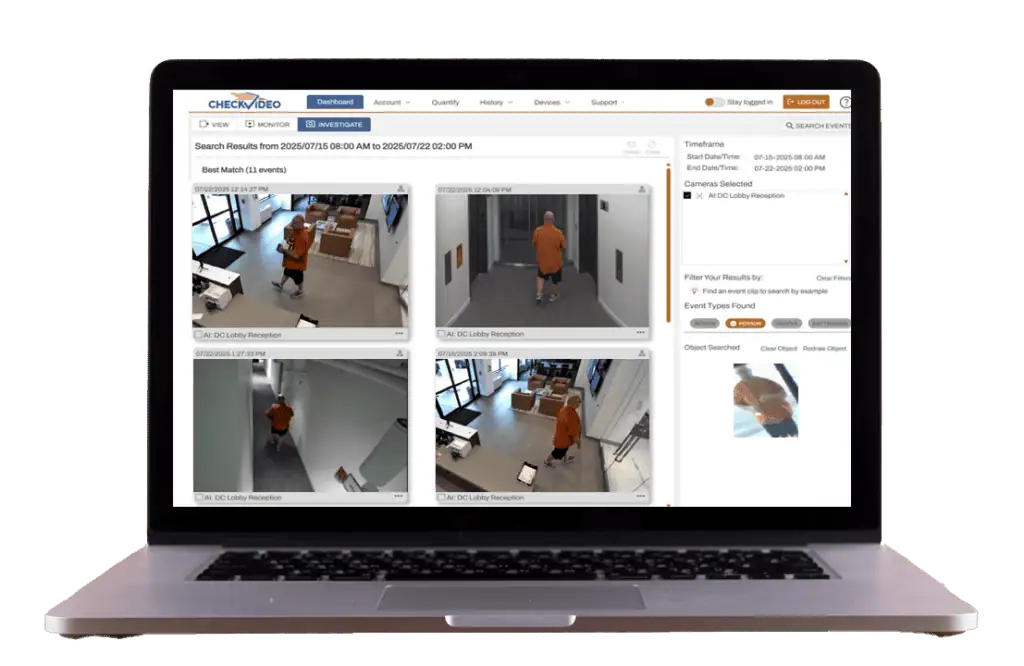
- Search for what you are looking for instead of scrolling
- Instantly narrow results by time, location, or activity
- View relevant clips across multiple cameras in seconds
Instead of spending hours reviewing footage, teams should be able to move from question to answer in minutes.
Setting a Realistic Benchmark
So what is a reasonable expectation?
For most investigations, the goal should be to find answers in seconds or within a couple of minutes, regardless of complexity. Simple events should be nearly instant, while even more involved investigations across multiple cameras should still be resolved quickly without manual effort or extended searching.
If your team is spending significant time reviewing footage, the problem is not effort. It is the limitation of the system.
Why Investigation Speed Matters
Faster investigations are not just about convenience.
They directly impact:
- Response time to active situations
- Ability to verify incidents before escalating
- Operational efficiency for security teams
- Confidence in your overall security strategy
The longer it takes to find answers, the less useful your system becomes in real world situations.
The Shift From Footage to Answers
Organizations are starting to rethink what they expect from video systems.
It is no longer enough to store footage. The real value comes from how quickly you can turn that footage into answers.
That shift is what separates traditional systems from modern AI powered platforms.
If you had an incident right now, how long would it take your team to find the answer?
That answer will tell you everything you need to know about your current system.
Learn More
If you want to see how faster investigations work in practice, contact us to learn more about how CheckVideo helps teams find answers across all cameras and all sites in seconds.